
Commercial Solar Panel Installation UK
Technical engineering, structural compliance, and high-voltage integration. How ACC Renewable Energy delivers megawatt-scale solar projects with zero operational downtime as your trusted commercial solar contractor.

Engineering Led by Kevin Boyle
MCS Nominated Technical Person
Commercial Solar Installation Services Across The UK
Deploying a commercial photovoltaic array is not simply a matter of fixing panels to a roof. It is a major infrastructure project that intersects with your building's structural integrity, your facility's high-voltage electrical network, and the national grid infrastructure. Selecting experienced commercial solar installers is critical to managing structural, electrical and regulatory risks while ensuring maximum return on investment.
At ACC Renewable Energy, our business solar installation services are delivered through a rigorous, engineering-led approach. We bypass the generic "sales first" model used by residential installers, focusing instead on risk mitigation, structural compliance, and technical excellence. From primary G99 grid modeling to the final commissioning of three-phase inverters, our in-house teams manage the entire turnkey commercial solar panel installation process for businesses across the UK.
Commercial Solar Installation As Part Of A Complete Solar PV System
A successful commercial solar installation is more than just placing hardware on a roof; it is the deployment of a complete, unified generation asset. When we design and install commercial solar PV systems, we ensure every component acts as a cohesive unit:
- Tier-1 Panels: High-yield modules engineered for longevity and low-light performance.
- Industrial Inverters: Robust three-phase inverters designed for heavy baseloads and seamless grid synchronization for industrial solar panel systems.
- Commercial Battery Storage: Integrated storage solutions for peak shaving and load shifting.
- Telemetry & Monitoring: Granular, string-level visibility to track yields and detect faults instantly.
- Ongoing O&M: Comprehensive operations and maintenance packages to protect your investment over its 25+ year lifespan.
Our Commercial Solar Installation Process
Successful commercial installations rely on meticulous pre-construction planning. We treat every project as a unique engineering challenge, following a strict operational methodology to ensure deployment is safe, compliant, and non-disruptive to your daily operations.
- Feasibility & Load Profiling: We analyze half-hourly meter data to model exact generation vs. consumption curves.
- Structural & DNO Approvals: Securing grid capacity and verifying building envelope tolerances.
- Pre-Construction Planning: Formulating RAMS, scaffold design, and logistical delivery schedules.
- Mechanical & Electrical Deployment: Safe roof access, mounting system construction, and heavy containment installation.
- Plant Room Integration: Integrating inverters and export limitation panels into existing LV/HV infrastructure.
- Testing & Handover: G99 witness testing, telemetry setup, and comprehensive O&M handover.
Structural Roof Surveys & Load Assessments
Commercial roof structures must be rigorously assessed before bearing the weight of a commercial solar array. A standard solar PV installation adds a "dead load" of approximately 15kg to 20kg per square metre.
More critically, the array fundamentally alters the aerodynamic profile of the building. We commission independent structural engineers to perform detailed wind uplift calculations based on the building's height, geographical exposure, and roof topography. This dictates the mounting methodology:
- Flat Roofs: Utilizing aerodynamically optimized, ballasted mounting systems to avoid roof membrane penetration, carefully distributing weight across load-bearing structural spans.
- Trapezoidal & Standing Seam: Using specialized, non-penetrative clamps or weather-sealed rivets that maintain the manufacturer's roofing warranty.
- Fragile/Asbestos Roofs: Deploying specialist crawling boards, safety netting, and bespoke fixing systems designed for older agricultural and industrial envelopes.
Commercial Solar Installation Benefits For Businesses
Choosing to proceed with a commercial solar installation is one of the most effective strategic decisions a business can make to protect its bottom line. A well-engineered system delivers immediate and compounding advantages:
- Reduce Energy Costs: Bypass expensive retail energy tariffs by generating your own power on-site at a fraction of the cost.
- Protect Against Rising Electricity Prices: Lock in a low Levelised Cost of Energy (LCOE) and shield your facility from wholesale gas market volatility.
- Improve ESG Targets: Visibly demonstrate corporate sustainability and meet increasingly strict supply-chain environmental requirements.
- Increase Energy Independence: Reduce reliance on the National Grid and protect against grid instability.
- Support Net Zero Objectives: Make an immediate, quantifiable reduction in your Scope 2 carbon emissions.
- Future-Proof Commercial Premises: Build the electrical infrastructure required to support the future integration of EV fleet charging.
Commercial Solar Installation Costs & ROI Considerations
When evaluating the viability of a commercial solar project, balancing CapEx against long-term operating savings is paramount. While initial installation costs vary depending on system size, containment requirements, and grid connection complexities, the financial returns are highly predictable and extremely lucrative.
Modern arrays protect your balance sheet against energy inflation while delivering a rapid return on investment. Furthermore, through the UK government's 'Full Expensing' scheme, businesses can claim 100% first-year capital allowances on commercial solar infrastructure, drastically reducing the net cost of the project. For a granular breakdown of capital expenditure and tax relief, explore our guide on commercial solar panel costs, or review our detailed payback period for commercial solar models. Businesses may also benefit from available tax incentives and support schemes covered in our guide to solar panel grants for businesses.
DNO Applications & Grid Compliance
Connecting generation equipment exceeding 16 Amps per phase to the National Grid requires explicit permission from your Distribution Network Operator (DNO). ACC Renewable Energy manages the entire G99 application process entirely in-house.
We conduct the necessary grid modeling to secure your connection offer. In scenarios where the local grid infrastructure is constrained, our engineers design and install highly sophisticated Export Limitation panels. These DNO-approved devices throttle the solar output when generation exceeds site demand, preventing unauthorized power from spilling onto the grid while allowing you to maximize the array size for self-consumption.
Health & Safety, CDM 2015 & RAMS
For Facilities Managers and Commercial Landlords, site safety is non-negotiable. ACC Renewable Energy operates as the Principal Contractor under the Construction (Design and Management) Regulations 2015 (CDM 2015).
Prior to mobilization, we provide comprehensive Risk Assessments and Method Statements (RAMS), alongside dedicated Construction Phase Plans. Our logistics team coordinates edge protection, MEWP (Mobile Elevating Work Platform) access, scaffold design, and crane lifts to ensure zero risk to your staff and zero disruption to your loading bays and operational workflow.
Commercial Solar Electrical Integration
The transition from DC generation on the roof to usable AC power in your facility requires industrial-grade electrical engineering. Our NICEIC-approved electricians are specialists in commercial plant room integration.
We install heavy-duty galvanised steel containment (cable trays and ladder racks) to route heavy SWA (Steel Wire Armoured) sub-mains from the roof array down to the plant room. We safely integrate large-scale, three-phase string inverters directly into your existing Low Voltage (LV) distribution boards, ensuring total phase balancing and compliance with BS 7671 wiring regulations. Electrical shutdowns are meticulously planned and typically executed out-of-hours to prevent operational downtime.
Installing Solar On Warehouses, Factories & Industrial Buildings
Different commercial environments present unique installation challenges. We adapt our installation methodology based on the sector:
- Warehouse Solar Installation: Managing massive cable runs, complex roof topographies, and coordinating with 24/7 logistics traffic during deployment.
- Industrial & Factory Solar: Integrating industrial solar systems with high-voltage machinery, managing harmonic distortion, and ensuring continuous baseload power supply.
- Retail & Office Solar: Prioritizing aesthetics, managing public access safety during installation, and integrating with advanced HVAC systems.
Commercial Battery Storage Integration
To maximize the utility of your solar array, we concurrently install commercial battery storage systems (BESS). Battery storage is one of the most commercially valuable services ACC offers, transforming how a business interacts with the grid. Our commercial solar contractors configure advanced energy management software to facilitate:
- Peak Shaving: Automatically discharging battery power during brief, localized demand spikes (like heavy machinery startups) to avoid costly 'Capacity' or 'Maximum Demand' grid charges.
- Load Shifting: Storing cheap overnight or weekend solar generation, and deploying it during the most expensive peak daytime tariff hours.
- Demand Charge Reduction: Smoothing out your facility's energy profile to permanently lower non-commodity utility bills.
- Emergency Backup Power (UPS): Providing an Uninterruptible Power Supply to keep critical infrastructure, servers, or cold-storage running during grid blackouts.
- Future EV Fleet Integration: Storing solar energy to charge commercial electric vehicles (eHGV and LGV) overnight without overloading the local grid connection.
Recent Commercial Solar Installation Projects
We pride ourselves on transparency and engineering excellence. Below are examples of recent commercial solar projects managed and delivered by the ACC technical team across different sectors.
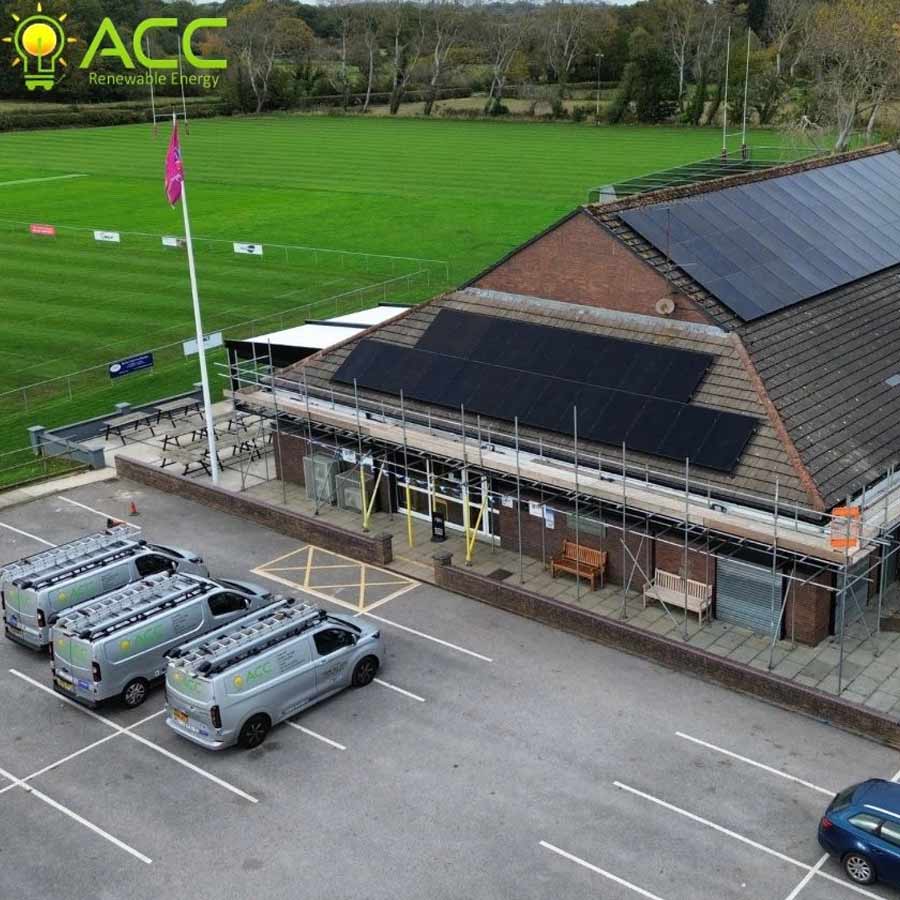
Commercial Sports Facility
Roof-mounted array deployed with minimal disruption to daily operations, heavily offsetting daytime facility running costs.
- System Size: 120 kWp
- Est. Generation: 105,000 kWh/yr
- CO₂ Reduction: 24 tonnes/yr

Community & Operations Centre
Clean plant room integration featuring three-phase inverters and commercial battery storage for maximum self-consumption.
- System Size: 65 kWp + 40kWh BESS
- Est. Generation: 56,000 kWh/yr
- CO₂ Reduction: 12 tonnes/yr
Why Commercial Clients Choose ACC Renewable Energy
Partnering with ACC Renewable Energy means partnering directly with a dedicated commercial solar installation company. From our base in Liverpool, we deliver commercial solar installations for businesses across the UK. We do not subcontract your project to third-party laborers. Your commercial solar installation is overseen by Kevin Boyle and our technical teams to deliver infrastructure that is built to perform and built to last. Our commercial clients trust us because we provide:
- In-House Installation Teams: Complete quality control from initial design to final plant room integration.
- MCS Certified Commercial Installers: Guaranteeing high engineering standards and eligibility for grid export tariffs (SEG).
- NICEIC Approved Electricians: Ensuring all complex three-phase and HV/LV electrical work complies with BS 7671.
- Dedicated Project Management: A single point of contact coordinating logistics, scaffolding, and DNO liaison.
- Commercial Risk Assessments: Rigorous CDM 2015 compliance, structural load analysis, and site-specific RAMS.
- Ongoing Monitoring & Maintenance: Post-installation O&M contracts and string-level telemetry to protect your ROI.
Commercial Solar Installation FAQs
Before installation, ACC commissions independent structural engineers to calculate both the static dead load (typically 15-20kg per sqm) and dynamic wind uplift aerodynamics. We then specify the correct mounting system—whether ballasted for flat roofs or penetrative rail systems for trapezoidal steel.
Our in-house technical team manages the entire Distribution Network Operator (DNO) process, from initial G99 grid modeling and application submission to installing DNO-approved export limitation panels and facilitating the final witness testing.
No. We operate under strict CDM 2015 regulations and provide detailed RAMS (Risk Assessments and Method Statements) prior to arrival. Our project managers coordinate heavy lifting, scaffolding, and electrical shutdowns (usually scheduled out-of-hours) to ensure zero disruption to your core business operations.
Installation timelines depend on system size and site complexity. A standard 50kW system may take 1-2 weeks, while a megawatt-scale industrial array can take several weeks or months. We provide detailed Gantt charts during the pre-construction phase.
Yes. We use aerodynamically optimized, ballasted mounting systems for flat roofs. This avoids penetrating the roof membrane and carefully distributes the dead load across the structural spans.
In most cases, roof-mounted commercial solar falls under Permitted Development Rights and does not require full planning permission. However, restrictions apply to listed buildings and conservation areas.
Yes, commercial battery storage can be retrofitted. We can design your initial solar installation to be 'battery-ready' by selecting compatible hybrid inverters or planning for AC-coupled storage in your plant room.
Solar PV requires minimal maintenance. We recommend an annual electrical inspection, performance telemetry monitoring, and occasional panel cleaning depending on local environmental factors (like dust or agricultural debris).
Yes. Under current UK tax rules, commercial solar installations often qualify for 100% first-year Capital Allowances via the 'Full Expensing' scheme, allowing businesses to deduct the full cost from their taxable profits in year one. You can learn more via our guide to solar panel grants and incentives, though we always advise confirming exact eligibility with your corporate accountant.
Page Contents
Request an Engineering Survey
Speak directly with ACC's technical team about load profiles, structural feasibility, and DNO compliance for your facility.