

Commercial Solar PV Systems for UK Businesses
For UK businesses, energy is no longer just a fixed overhead—it is a volatile variable cost directly threatening bottom-line profitability. Implementing Commercial Solar Panels in the UK is an essential, proactive strategy for protecting profit margins, establishing predictable long-term operational expenditure, and taking absolute control of your energy procurement strategy.
Unlike generic, residential-focused installers, our commercial solar photovoltaic (PV) systems require rigorous engineering. The scale of generation, the complexity of three-phase electrical integration, and stringent Distribution Network Operator (DNO) compliance demand specialist commercial expertise.
Why Commercial Solar Now?
- Energy Inflation: Protect margins against unpredictable wholesale gas market spikes and rising grid tariffs.
- Operational Resilience: Shield your facility from grid instability and rising non-commodity grid reinforcement charges.
- ESG & Net Zero Pressure: Meet increasingly strict corporate carbon reporting mandates and supply chain ESG requirements instantly.
- Rapid Cost Reduction: Generate electricity at a Levelised Cost of Energy (LCOE) frequently between 4p and 6p per kWh.
By generating electricity directly at the point of consumption, businesses bypass transmission charges and green levies. The resulting decrease in imported grid energy provides immediate operational cost reduction, while the reliable lifespan of tier-one solar hardware ensures a highly visible commercial solar ROI.
Commercial Solar Experience Across Multiple Sectors
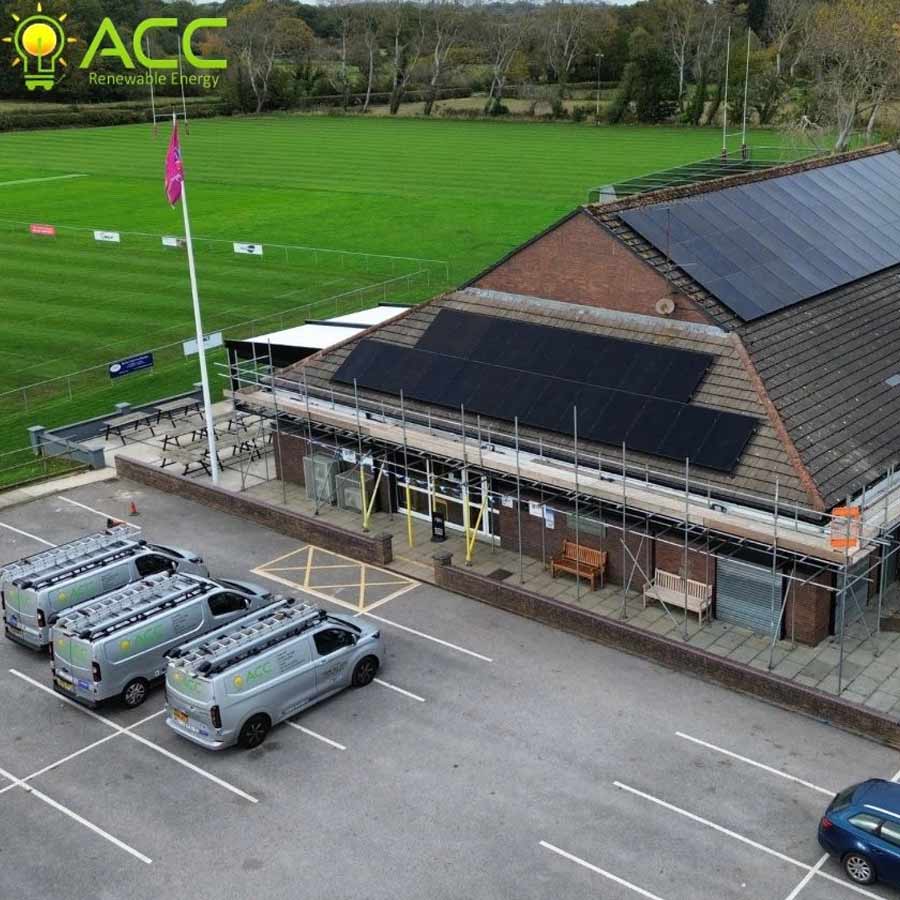
ACC Renewable Energy has extensive, hands-on experience supporting commercial solar installations across warehouses, industrial premises, agricultural buildings, office facilities, retail parks and mixed commercial estates throughout the North West and the wider UK, including Liverpool, Manchester, Cheshire, Lancashire and North Wales commercial projects.
We understand that installing active generation equipment on a live commercial site requires rigorous operational planning. Our project managers ensure zero disruption to your core business activities during deployment. This real-world operational proof demonstrates our ability to deliver highly complex, high-yield systems on time, within budget, and fully compliant with CDM 2015 regulations.
Commercial Solar Systems Designed Around Your Energy Demand
Commercial energy profiles dictate system scale. We engineer solutions matched perfectly to your half-hourly load profile, ensuring maximum efficiency whether you operate an SME premises or a heavy industrial site:
- Small Commercial Systems (10kW - 50kW): Ideal for independent retailers, small commercial offices, and light manufacturing units looking to offset high daytime usage.
- Medium Business Arrays (50kW - 250kW): Perfectly sized for standard logistics warehouses, medium-sized agricultural operations, schools, and larger office blocks.
- Large Industrial Installations (250kW - 1MW+): Engineered for heavy manufacturing plants, cold storage facilities, and massive logistics hubs with continuous, demanding baseloads.
- Multi-Building Estates: Complex micro-grid and export limitation setups distributed across mixed-use commercial and industrial parks.
Core Technical Capabilities
Commercial infrastructure requires industrial-grade electrical engineering. Our in-house technical capabilities separate ACC Renewable Energy from standard solar installers:
Solar Solutions by Business Sector
Warehouses and Logistics Centres
Logistics facilities represent the ideal environment for commercial solar deployment. They typically feature vast, unobstructed roof structures capable of supporting megawatt-scale arrays. While a standard warehouse base load may be relatively low compared to its massive footprint, consistent energy demands are created by automated sorting, conveyor systems, 24/7 high-bay LED lighting, and heavy material handling equipment.
Furthermore, the shift towards electric commercial vehicle (eHGV and LGV) fleets presents a massive future energy requirement. A carefully planned solar array future-proofs logistics hubs, providing low-cost onsite generation to power EV charging networks.
Manufacturing and Industrial Facilities
Because industrial facilities consume massive amounts of power during daylight hours, the self-consumption rate of solar generation often approaches 100%. For these environments, we specify ruggedised industrial solar panel systems designed to withstand harsh atmospheric conditions. We seamlessly manage the complex integration of solar inverters into existing infrastructure without disrupting operational continuity.

The Financial Justification: ROI & Operational Savings
When assessing financial viability, Financial Directors must evaluate the Levelised Cost of Energy (LCOE). Compared to commercial grid tariffs—which frequently exceed 20p to 30p per kWh—the unit economics of onsite generation are vastly superior.
Tax Incentives
Under current UK capital allowance regimes, businesses can utilize the 'Full Expensing' scheme, deducting the full capital expenditure of the solar installation from taxable profits in year one.
ESG Compliance
Solar PV offers a quantifiable reduction in Scope 2 emissions, ensuring immediate compliance with SECR mandates and attracting ESG-conscious tenants or investors.
The Commercial Solar Installation Process
Executing a commercial project requires meticulous project management. Read our full methodology in our guide to commercial solar panel installation.
Site Survey
Structural & electrical assessment.
Energy Analysis
Load profiling & ROI projection.
DNO/G99
Grid connection approval.
System Design
MCS compliant engineering.
Installation
Safe, low-disruption deployment.
Commissioning
Testing & telemetry handover.
Commercial Roof Types We Support
Our structural engineers specify appropriate, safe mounting systems for all commercial building envelopes, including:
Commercial Battery Storage Systems
To unlock advanced energy management capabilities, we frequently integrate battery storage for commercial solar systems. Commercial Battery Energy Storage Systems (BESS) fundamentally change how a facility interacts with the grid.
- Maximising Self-Consumption: Store surplus weekend/holiday generation for deployment during peak operational hours.
- Peak Shaving: Avoid costly 'Maximum Demand' or 'Capacity' charges by discharging batteries during localized demand spikes (e.g., machinery startup).
- Uninterruptible Power Supply (UPS): Ensure operational continuity for critical infrastructure during grid blackouts.
Commercial Solar Costs and Payback Periods
Understanding capital requirements is critical for board-level approval. While exact pricing depends heavily on site-specific variables, the cost per installed kilowatt benefits significantly from economies of scale. For an accurate project cost based on your premises and energy requirements, request a tailored solar quote.
The payback period for commercial solar in the UK typically ranges between 3 to 6 years for heavily utilized facilities. Given that a well-maintained system operates efficiently for over 25 years, this represents a highly lucrative long-term investment.
Frequently Asked Questions
Most commercial systems we install currently achieve a full Return on Investment (ROI) within 3 to 6 years. The exact timeline depends on your facility's energy consumption profile, the unit rate you currently pay your energy supplier, and the total capital cost of the installed system. Because solar hardware has a 25+ year lifespan, the long-term financial yield post-payback is exceptionally high.
In the vast majority of cases, roof-mounted commercial solar panels fall under Permitted Development Rights in the UK and do not require formal planning permission. However, exceptions exist if your building is listed, in a conservation area, or if panels protrude significantly. We manage all necessary planning checks prior to installation.
Yes. Commercial entities can export surplus energy to the National Grid via the Smart Export Guarantee (SEG) or through bespoke Power Purchase Agreements (PPAs) with energy suppliers. However, the most financially lucrative strategy is always to maximize 'self-consumption' (using the power onsite) as the savings on imported electricity far outweigh standard export tariffs.
Solar PV is one of the most immediate and effective methods for commercial landlords to improve a building's Energy Performance Certificate (EPC) rating. Under the Minimum Energy Efficiency Standards (MEES), commercial properties must meet strict efficiency ratings to be legally lettable. A commercial solar array dramatically improves this rating, protecting the asset's value and attracting ESG-conscious tenants.
A standard solar PV array adds approximately 15kg to 20kg of dead load per square metre. Before any system is designed, ACC Renewable Energy commissions independent structural engineers to perform rigorous load-bearing calculations to ensure the building envelope can safely support the system alongside dynamic wind and snow loads.
Many businesses utilize asset finance, commercial loans, or hire purchase agreements to fund installations, allowing the energy savings to effectively pay off the finance over time. Alternatively, fully-funded Power Purchase Agreements (PPAs) are available where a third party installs and maintains the system for free, and your business buys the generated electricity at a heavily discounted fixed rate.
You must notify your commercial property insurer before installing solar panels. Because ACC Renewable Energy systems are designed and installed by MCS and NICEIC-approved engineers using tier-one components, insurers rarely raise premiums significantly. In fact, compliant, safely installed systems are viewed as standard structural upgrades.
Solar PV systems have no moving parts and require minimal maintenance. We recommend an annual visual inspection and electrical test, alongside periodic panel cleaning (especially in industrial or agricultural environments with high dust/debris) to ensure the system continues operating at peak efficiency. We offer comprehensive Operations and Maintenance (O&M) packages.
High-quality, Tier-1 commercial solar panels come with a 25-year linear performance warranty, guaranteeing they will still produce at least 80% to 85% of their original output after a quarter of a century. The system's inverters, which manage power conversion, typically require replacement every 10 to 15 years.
Our installations include enterprise-grade telemetry. The inverters connect to a secure cloud portal, providing real-time data on generation, site consumption, and grid export. This granular visibility allows for proactive maintenance—if a string underperforms, automated alerts are generated so our technical team can resolve the issue swiftly.
Page Contents
Request a Commercial Solar Assessment
Speak directly with ACC Renewable Energy about commercial solar system design, projected energy savings, battery storage integration and ROI forecasting for your premises.
Request Your Free Site Assessment →